Page Summary
- Natural Family Planning (NFP) is an umbrella term for certain research-based fertility literacy methods that are used by married couples to achieve and avoid pregnancy.
- NFP is different from contraception, because when couples contracept, they engage in sexual activity while deliberately impeding their complete union and the possibility of new life. Unlike contraception, NFP methods don’t tamper with the content of conjugal activity.
- This Quick Reference Guide can help you choose which NFP method is right for you.
Is Natural Family Planning the same as contraception?
No.
Ok, but what does that actually mean?
Listen to this article
Looking back on their 35 years of marriage, Hal and Susan realized how Natural Family Planning had played a pivotal role. Early on, when they were barely scraping by financially, they switched from contraception to Natural Family Planning, but didn’t expect it to make much of a difference to their relationship. They were surprised how much it improved their cooperation and communication.
Once they became confident in their understanding of their mutual fertility, and despite some moments of struggle to abstain during fertile times, they successfully postponed pregnancy. At the same time, they also grew in their openness to life and realized that they wanted to try to have more babies! Natural Family Planning unfettered their relationship, enabling a deep connection that they wouldn’t trade for anything.
What is Natural Family Planning?


Natural Family Planning (NFP) is an umbrella term for certain research-based fertility literacy methods that are used by married couples to achieve and avoid pregnancy. The information gained by a woman who uses NFP also has a medical application since it provides data about her reproductive health. NFP methods have been in development since the late 1970s. Over the years, other terms have been used interchangeably with NFP.
Unlike the “Rhythm” method, NFP methods teach women how to understand the biomarkers of their fertility, based on the observation of naturally occurring signs and symptoms of the fertile and infertile phases of a woman’s menstrual cycle. These biomarkers are related to changes in the woman’s reproductive hormones, notably: estrogen, luteinizing hormone, and progesterone. Any woman can use this information to identify the fertile and infertile phases of her menstrual cycles.
How is NFP different from contraception?
When couples contracept, they engage in sexual activity while deliberately impeding their complete union and the possibility of new life. Unlike contraception, NFP methods don’t tamper with the content of conjugal activity. For this reason, these methods can strengthen marriage. NFP relies on couple communication and responsible behavioral change. NFP methods require husband and wife to cooperate with each other in the most intimate area of their lives.
During times of periodic sexual abstinence, husband and wife live a renewed courtship as they discover non-sexual ways to express their love for each other. These methods work best when husbands “tune into” their wives’ cycles and both spouses speak openly about their sexual desires and family hopes. For faith-focused couples, these methods also foster prayerful discernment of God’s will for their marriage.
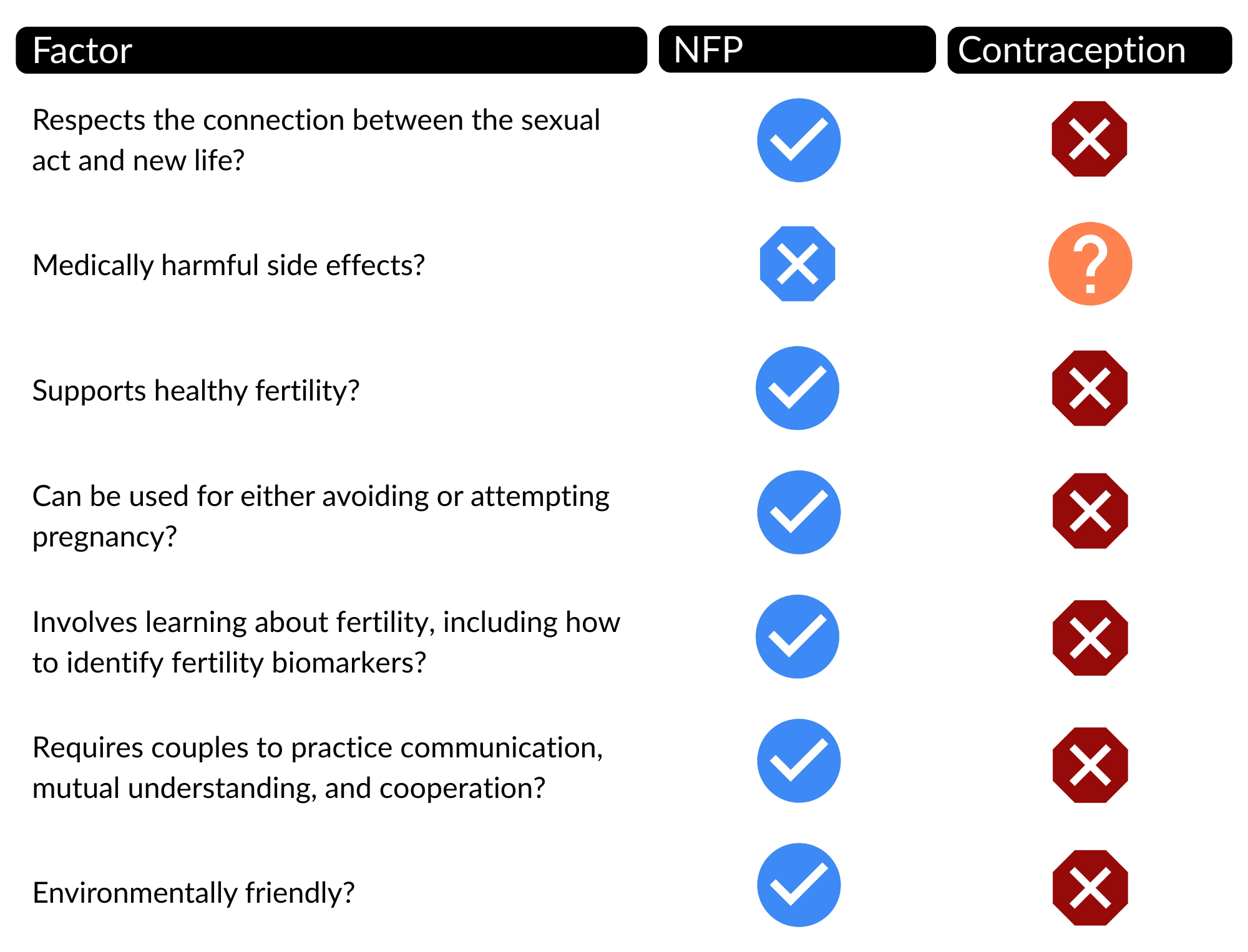
NFP methods can be highly effective for avoiding pregnancy. Research indicates that perfect use of most NFP methods can be as effective as 98% while imperfect use can have a range of 84–90% effectiveness. NFP rates for pregnancy avoidance depend upon how well the couple learns and applies the NFP method’s guidelines and whether the couple is clear about their family planning intention—whether trying to space or limit pregnancies.
Another difference from contraception is that NFP methods can be used to achieve pregnancy for couples who struggle to conceive. When attempting a pregnancy, couples who have healthy fertility and randomly have intercourse throughout the female menstrual cycle have a 15–25% chance of conceiving a baby in each menstrual cycle. When using an NFP method to time intercourse to the fertile phase of each cycle, the average rate can be doubled or tripled, with most couples achieving pregnancy in three menstrual cycles.
Learn more about the evidence of the benefits of NFP. Some methods of contraception (e.g. hormonal drugs) have serious negative side effects for users.
How do I choose an NFP method?
Choosing which NFP method to practice in married life will depend upon what kind of biomarkers spouses want to understand and track. Although a particular method of NFP can be used for many years, sometimes couples will change their NFP method when different information is needed. That is why it is important to know that there are many NFP methods that can help. For example, if a woman cannot easily understand one biomarker such as cervical mucus, she may need the help of a fertility monitor or a Basal Body thermometer to better identify the fertile and infertile phases of her menstrual cycle. In addition, various reproductive times in a woman’s life (such as post-partum and breastfeeding or perimenopause), may require a different method of NFP. This Quick Reference Guide can help narrow down the choices.
Natural Family Planning reflects the dignity of the human person within the context of marriage and family life, promotes openness to life, and recognizes the value of the child. By respecting the love-giving and life-giving aspects of marriage, NFP can enrich the marital bond!
For more information, visit usccb.org/nfp.