Page Summary
- The more time a user spends with an AI chatbot, the more isolated that person becomes.
- The AI marketing pitch rests on an assumption that you can’t do what they’re offering to do for you. But you can, and you can turn to other human beings for help!
- AI is not like other labor-saving technology (e.g. washing machines, cars), because it replaces something only people can do: rational communication.
- Each person is created in the image and likeness of God, so when a chatbot falsifies rational activity, it counterfeits the work of God. This could become a novel form of idolatry.
- Chatbots can’t replace relationships, because they can’t replace you.
How should we interact with generative AI?
Generally speaking, it’s not a good idea to interact with it.
Ok, but what does that actually mean?
Listen to this article
The more a person interacts with generative AI, the more dangerous it can become. Whether it’s to summarize documents; generate text, images, and music; or just to chat, the software is designed to capture the user’s attention. That design is backed by billions of dollars and cutting-edge techniques for manipulating human psychology. The more time a user spends with it, the more isolated that person becomes from real people and real relationships.

It is not good for the man to be alone.
Genesis 2:18

The AI marketing pitch rests on an underlying assumption that you can’t do what they’re offering to do for you. Then the examples they give are activities that can in fact be done by people. They are the sorts of activities that only people can do. Having trouble finding music for a road trip playlist? AI can help. You can’t do it on your own. You can’t plan a meal for date night. You can’t learn a workout routine. You can’t read a book or an article or a paragraph, and draw your own conclusions. You can’t, you can’t, you can’t.
You can! Ask a friend or family member for help. Find a trustworthy human being who specializes in that subject. Depending on other people (within reason) is a great way to build relationships. But if tech companies convince us that AI is indispensable for the things we’ve always done together, we will find ourselves more alone.
Now, there are some abilities we’ve lost, like the immediate ability to wash our clothes in a river, that are probably fine to lose. Clothes-washing is not an intrinsically rational act. You could probably train a monkey to do it if that was an easier option than a washing machine. But communicating, rationally relating to another person, is not like washing clothes.


What about the horse-drawn carriage argument?
Some advocates of AI appeal to the example of horse-drawn carriages getting replaced by automobiles. In that line of thinking, it was arguably a good thing in the long run, and the advancements offered by generative AI in a variety of fields are no different.
But not everything is like a horse-drawn carriage waiting to be replaced by a car. Someone who compares transportation to rational communication only reveals that he has an impoverished understanding of the spoken and written word. Transportation is not intrinsically rational (as indicated by the involvement of the horse).
Language is intrinsically rational, and it’s one of the main ways we know and love both the world around us and the people who care about us. The point of language is not to get somewhere as fast as possible. The point is to be united with an objective reality beyond ourselves. That’s what relationships are all about. That’s what a good life is all about.1
These uniquely human activities are at stake in the AI debate. The point of those activities is not a certain amount of utilitarian output, the point is to know and to love. When spouses watch a sunset together, their goal isn’t to hit a certain benchmark of watching 10 or 500 or 20,000 sunsets as quickly and easily as possible. Their goal is to be present to each other.
AI developers pose a challenge that’s not only about job loss, but also about the human person and how low he seems to have sunk in the estimation of AI advocates. Instead of trying to replace a horse and carriage, they threaten to replace loved ones.
Each human person is created in the image of God, who is the origin of personhood itself. So, when chatbots and other software impersonate distinctly rational activity, they don’t just falsify human identity; they counterfeit the work of God. This could become a novel form of idolatry.
Their idols are silver and gold, the work of human hands. They have mouths but do not speak, eyes but do not see. They have ears but do not hear, noses but do not smell. They have hands but do not feel, feet but do not walk; they produce no sound from their throats. Their makers will be like them, and anyone who trusts in them
Psalm 115: 4-8
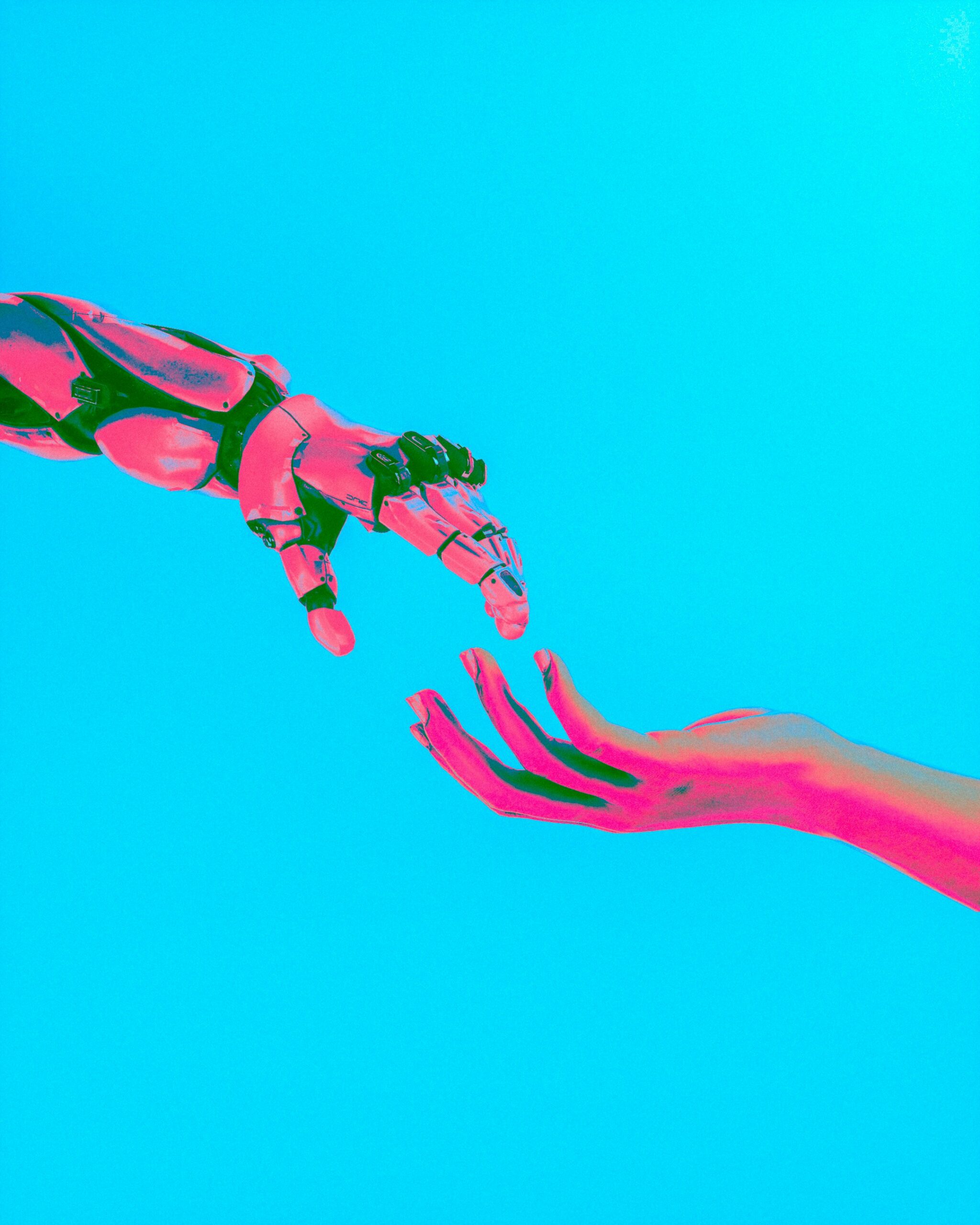
This warning shows how idolatry harms the people who practice it. When they worship what they make (something less than human), they lose their humanity. Something similar is to be expected in the present day. Attempting to relate to chatbots wouldn’t exactly be worship, but it requires the user to unwittingly pretend that a non-divine actor is playing a role that only God can fill.
Chatbots can’t replace relationships, because chatbots can’t replace you. You are unrepeatable, and no software can reduce your existence to a series of next-token predictions, no matter how sophisticated they appear to be.
However, the presumption of substituting God for an artifact of human making is idolatry, a practice Scripture explicitly warns against (e.g., Ex. 20:4; 32:1-5; 34:17). Moreover, AI may prove even more seductive than traditional idols for, unlike idols that ‘have mouths but do not speak; eyes, but do not see; ears, but do not hear’ (Ps. 115:5-6), AI can ‘speak,’ or at least gives the illusion of doing so (cf. Rev. 13:15).
Dicastery for the Doctrine of the Faith and Dicastery for Culture and Education, Antiqua et Nova 105
What about “creative prompting”?
Keep reading in part 3.

1) DC Schindler, “AI as a Very Deepfake,” New Polity, February 10, 2026. https://newpolity.com/blog/ai-as-a-very-deepfake, accessed April 1, 2026.
Choose your next step:
Resources for a healthy understanding of
AI
Magnifica Humanitas
Pope Leo XIV
Preseving Human Voices and Faces
Pope Leo XIV
AI as a Very Deepfake
DC Schindler
Antiqua et Nova
Vatican Dicasteries

Catholic Faith + AI Resources
Daughters of St. Paul